On 15 January 2026, Uganda held its general elections for the presidency, parliament, and local government. For most of the country, that electoral period and election day represented collective civic engagement with partners, queues at polling stations, ballot papers, and results trickling in. For women human rights defenders (WHRDs) across Uganda, it represented something different: the culmination of months of heightened surveillance, coordinated digital attacks, threats, and the relentless pressure of doing rights work in one of the most challenging political environments in the region, with an internet shutdown.
The Context: Elections as a Flashpoint for Digital Violence Against WHRDs
Elections in Uganda do not simply test democratic institutions; they test the bodies and resilience of the women who serve and defend those institutions. Research by Freedom House has consistently rated Uganda as ‘Not Free,’ citing restrictions on political opposition, civic space, and internet freedom. Collaboration on International ICT Policy in East and Southern Africa (CIPESA) report noted that elections are routinely accompanied by internet throttling, restrictions on social media platforms, a kill switch, and coordinated information operations targeting activists and opposition figures, especially in structurally excluded communities. The 2026 cycle was no exception. The No signal, No voice report by UnwantedWitness Uganda and Women of Uganda Network (WOUGNET) tracked multiple incidents of partial internet shutdowns and social media throttling in the weeks surrounding the election; these shutdowns were not inconveniences; they were targeted disruptions of their work.
The global evidence base reinforces this. A 2023 report by the UN Special Rapporteur on the situation of human rights defenders documented that women human rights defenders face a ‘double risk’ during elections: the risks faced by all human rights defenders are compounded by gendered threats, including sexual harassment, online violence, and smear campaigns designed to discredit and silence them. The Front Line Defenders Global Analysis 2024 found that women defenders face higher rates of digital surveillance and online abuse than their male counterparts, and that election periods significantly amplify these risks.
In Uganda’s specific context, WHRDs documenting human rights violations, or advocating for political accountability, operate under the additional weight of the Computer Misuse Act, provisions of the Penal Code criminalising ‘offensive communication,’ and a legal environment in which digital evidence is routinely collected against activists rather than for them. The shrinking of civic space, documented by the CIVICUS Monitor, creates a structural context in which WHRDs engaged in ordinary rights work face extraordinary risks.
During and After the Election: What WHRDs Experienced
Uganda’s January 2026 elections took place in a context that confirmed many of the risks WOUGNET’s preparedness work had anticipated. Reports from WHRDs in WOUGNET’s networks and partner organisations described a range of experiences, painting a picture of a digital environment that remains structurally and historically hostile to women’s rights work.
As in previous election cycles in Uganda, access to social media platforms was disrupted in the days leading up to the election, mirroring patterns documented by NetBlocks and Access Now’s KeepItOn coalition.
Coordinated Online Attacks and Disinformation
Several WHRDs documented coordinated online attacks pre, during and post election period, including targeted harassment campaigns, impersonation of their accounts, and the spread of disinformation about their work and personal livesfor example, Agatha Atuhaire who has continuously faced Persistent propaganda and false claims aimed at discrediting her work and personal reputation, which often intensified around her exposés on government spending, sexual harassment in NGOs, or election-related repression and Mutuzo Misheline who has continuously faced coordinated attacks involving abusive content, trolling, and attempts to exploit personal details (e.g., related to her activism on sexual harassment, education, or political issues). These are not spontaneous outbursts: as the Oxford Internet Institute’s Computational Propaganda Project documented extensively, coordinated inauthentic behaviour is increasingly used to silence civil society voices during electoral periods across Africa. For WHRDs working on election monitoring, documentation of gender based violence (GBV) at polling stations, or civic education, these attacks were a direct attempt to compromise their ability to do their work.
The AI dimension of this threat is growing. As noted at WOUGNET’s and FIDA Uganda’s High-Level Dialogue on TFGBV in March 2026, AI-generated deepfakes and synthetic media are making it easier to create false, damaging content targeting women that is difficult to refute, spreads rapidly, and causes lasting reputational and psychological harm. Several WHRDs reported encountering manipulated images during the election period, echoing concerns raised by the Global Network Initiative about platforms’ responsibility for harmful AI-generated content.
What WOUGNET Did: Building Preparedness and Before the Polls
WOUGNET did not wait for the elections to arrive before acting. Through the Reclaiming Our Spaces: Holistic Security and Strategies for Women Human Rights Defenders in Uganda project, implemented from May to December 2025 and supported by the Association for Progressive Communications under a project named Safety for voices, WOUGNET built a feminist-informed, WHRD-led preparedness and response capacity-building initiative that reached across Central, Eastern, Northern, and Western Uganda.
Co-Creating the Holistic Security Toolkit
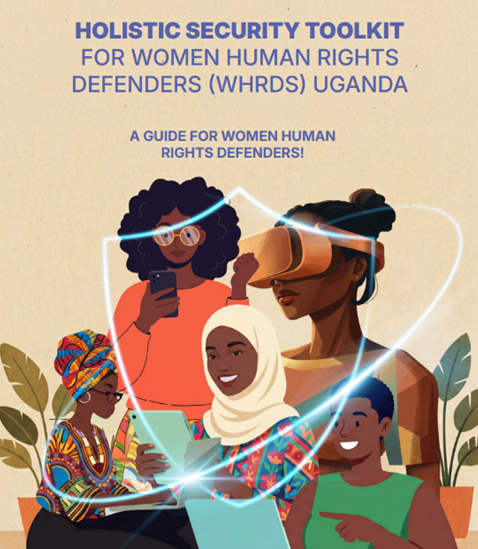
The foundation of WOUGNET’s pre-election preparedness was a Holistic Security Toolkit co-created directly with WHRDs from multiple regions through consultative virtual engagements. This was not a manual written for WHRDs; it was one written with them, ensuring that the tools and strategies reflected lived realities, contextual risks, and the feminist principles of care and collective protection. The toolkit covered digital security, physical security, and psychosocial wellbeing as an integrated whole, recognising that no single dimension of safety can be addressed in isolation from the others.
Training of Trainers: Building a Self-Sustaining Safety Network
Just weeks before the election, WOUGNET conducted an in-person Training of Trainers (ToT) workshop with over 30 WHRDs and feminist trainers. The ToT model was deliberate: rather than delivering one-off trainings to individual WHRDs, WOUGNET invested in building a cadre of grassroots feminist trainers and digital safety mentors capable of cascading knowledge into their own communities. These trained trainers reached over 150 WHRDs across Uganda’s districts located in various regions, such as Soroti, West Nile, and Hoima, with decentralised training on digital, physical, and psychosocial security.
Caroline Cherop, Executive Director of Young Wombs Trauma Centre, reflected: “WOUGNET’s holistic security initiatives have achieved rapid, tangible impact. By equipping a network of trainers and defenders with a tested toolkit and facilitation skills, the project ensures that safety knowledge is spreading organically.”
Achom Juliet, WHRD from Soroti, trained under WOUGNET’s Reclaiming Our Spaces project, mentioned that,“Before this training, I thought digital attacks were just something I had to endure. Now I know how to protect myself, document abuse, and reach out for support. I no longer feel alone.”
These are not just stories; they are evidence showcasing the impact of the toolkit and how WHRDs are transferring the skills they have learned to their communities for collective learning, care and protection.
Digital Security Audits and Protective Tools
Ahead of the election, WOUGNET conducted tailored digital security audits with 20 organisations and 20 individuals, providing customised recommendations and distributing VPNs equipped with antivirus protection, browser alerts, and incognito browsing. These tools were specifically chosen to address election-related risks: internet shutdowns, surveillance of social media activity, and the blocking of specific platforms that Ugandans rely on for communication and coordination. Recipients learned not just that VPNs exist, but how to use them, why they matter, and what additional practices, such as strong passwords, encrypted messaging, and reduced sharing of sensitive information, they need to pair with technical tools.
Psychosocial Support: Centering Care as a Political Act
WOUGNET’s approach recognised from the start that security is not only technical. WHRDs do not face burnout because they lack VPNs; they face burnout because they carry the weight of others’ pain while navigating their own risk. The project integrated psychosocial support and collective care sessions throughout the programme, creating safe spaces for healing, reflection, and solidarity.
A woman counsellor from Nakawa Division had this to say, “The psychosocial session reminded me that rest and care are also part of resistance. I feel stronger and more committed to my work.”
According to a participant from West Nile who participated in WOUGNET’s digital security audit programme, she mentioned that, “After the security audit, our organisation changed how we store information and communicate. We feel safer, especially when working on sensitive cases.”
The Confidence That Came From Being Prepared
Against this difficult backdrop, WHRDs who had participated in WOUGNET’s preparedness programme reported meaningfully different experiences from those who had not. They reported feeling better equipped to anticipate threats rather than react to them in panic. They had peer networks to turn to when incidents occurred. They knew how to document abuse in ways that could support future reporting or legal action. And they had the psychosocial grounding to continue their work rather than withdraw.
This is not a small thing. Based on research by the Association for Progressive Communications (APC) on women’s experiences of online violence, it consistently found that the most significant response to digital attacks is withdrawal, leaving platforms, self-censoring, and reducing visibility. WOUGNET’s preparedness work is explicitly designed to interrupt that dynamic: to give WHRDs the tools, knowledge, and solidarity they need to stay present and continue their work even under attack.
Based on our assessment for the digital safety hub for 2025, we found out that: “WHRDs engaged more deeply with their communities when their emotional well-being was acknowledged and supported, reducing burnout and strengthening long-term engagement.”
Key Lessons: What the Elections Taught Us
Holistic security must be continuous, not event-driven
The elections exposed a fundamental limitation of project-cycle holistic security programming: threats do not respect reporting periods. The training and tools provided before the election were invaluable, but WHRDs’ needs do not end when polls close. Surveillance continues. Retaliation for election-period documentation happens weeks or months later. The psychological toll accumulates over time. WOUGNET’s own analysis, consistent with Front Line Defenders’ research on WHRD safety, points to the need for multi-year, phased programmes with ongoing mentorship, refresher sessions, and adaptive responses to emerging threats.
Technical tools without psychosocial support are incomplete
One of the most consistent findings from WOUGNET’s post-training reflections and from the broader evidence base assembled by organisations, including Digital Rights Foundation and TacticalTech, is that technical security tools are necessary but not sufficient. A WHRD who has a VPN but no peer support network, no psychosocial grounding, and no organisational security policy is still deeply vulnerable. Holistic security means exactly that: addressing the digital, physical, and emotional dimensions as an integrated whole.
The legal environment remains a critical gap
WOUGNET’s preparedness work equipped WHRDs to be safer, but it cannot change the legal environment in which they operate. Uganda’s legal framework still lacks explicit provisions addressing TFGBV, non-consensual image distribution or circulation, and AI-generated deepfakes. The partial invalidation of the Computer Misuse Act creates uncertainty. Evidence standards in courts remain inadequate for digital evidence. As the International Federation for Human Rights (FIDH) has noted in its documentation of shrinking civic space in Uganda, legal impunity for digital attacks against human rights defenders is a structural enabler of those attacks. Without legal reform, technical preparedness remains a mitigation, not a solution.
Cross-movement solidarity is a security strategy
The peer networks built through WOUGNET’s training-of-trainers (ToT) model proved their value during the election period. WHRDs who knew they had colleagues they could call, signal, or reach via WOUGNET’s rapid response channels felt less isolated during attacks. This points to something broader: solidarity is not just a value, it is a security infrastructure. Building and sustaining cross-movement networks of WHRDs, connecting urban defenders to rural colleagues, and linking national advocacy to global coalitions (such as the Women’s Rights Online Network of which WOUGNET is a member) are all forms of security investment.
What Now: WOUGNET’s Post-Election Priorities
The elections are over. The risks are not. WOUGNET’s post-election priorities reflect the lessons above and the continuing needs of WHRDs whose work does not pause because a result has been declared.
- Continue rapid response support through the OGBV Knowledge Portal and toll-free channels for WHRDs facing post-election retaliation or continuing digital attacks
- Facilitate follow-up mentorship and refresher sessions with trained training of trainers (ToTs) to reinforce skills, address new threats (particularly AI-generated content), and sustain the peer networks built before the election
- Advocate for legal reform, working with partners including FIDA Uganda, the Personal Data Protection Office (PDPO), and Uganda Communications Commission (UCC) to push for explicit legal protections for WHRDs in digital spaces, including provisions addressing TFGBV and digital evidence admissibility
- Expand the reach of the Holistic Security Toolkit to WHRDs in structurally silenced communities, particularly rural WHRDs, WHRDs working with structurally silenced communities, and WHRDs from other high-risk regions where connectivity and digital literacy remain barriers
- Document the election-period experiences of WHRDs in WOUGNET’s networks, producing survivor-centred, anonymised evidence that can inform platform accountability advocacy, legal reform processes, and future programming
- Strengthen organisational security policies, moving beyond individual skill-building to help WHRDs’ organisations develop institutional security practices that protect entire teams
Closing: Still Standing, Because We Prepared Together
The 2026 Ugandan elections tested the resilience of women human rights defenders in ways that were predictable because we have seen it before and still painful, because preparation does not eliminate harm. But it changes its impact. WHRDs who went into the election period with the knowledge, tools, peer support, and psychosocial grounding that WOUGNET’s programme provided were not invulnerable. They were, however, better able to stay present, document what they witnessed, support each other, and continue their work.
That is what safety looks like in practice for WHRDs in Uganda: not the absence of threat, but the presence of capacity, solidarity, and the conviction that you are not alone. WOUGNET exists to build and sustain that capacity. And we remain committed to it not just in the months before an election, but in the long, unglamorous work of building a Uganda where every woman human rights defender can do her work safely, in every space, digital and physical, that she chooses to occupy.
As stated by one of the WHRDs in our report, “Holistic security approaches are most effective when co-created, not imposed. WHRDs require ongoing mentorship and peer networks, not one-off training, to sustain security practices.”
By Esther Nyapendi, Women of Uganda Network (WOUGNET)